
Introduction
In 2020, a decades-old scientific challenge that had frustrated researchers around the world took an unexpected turn. A team at DeepMind unveiled AlphaFold2, an artificial intelligence system capable of predicting the three-dimensional structure of proteins with remarkable accuracy. Protein folding had been one of biology’s most difficult computational problems for nearly fifty years because a protein’s function depends on its shape, yet experimentally determining that shape could take months or even years.
AlphaFold dramatically shortened this timeline. Within a few years, researchers gained access to predicted structures for hundreds of millions of proteins, accelerating work in drug discovery, disease research, agriculture, and biotechnology.
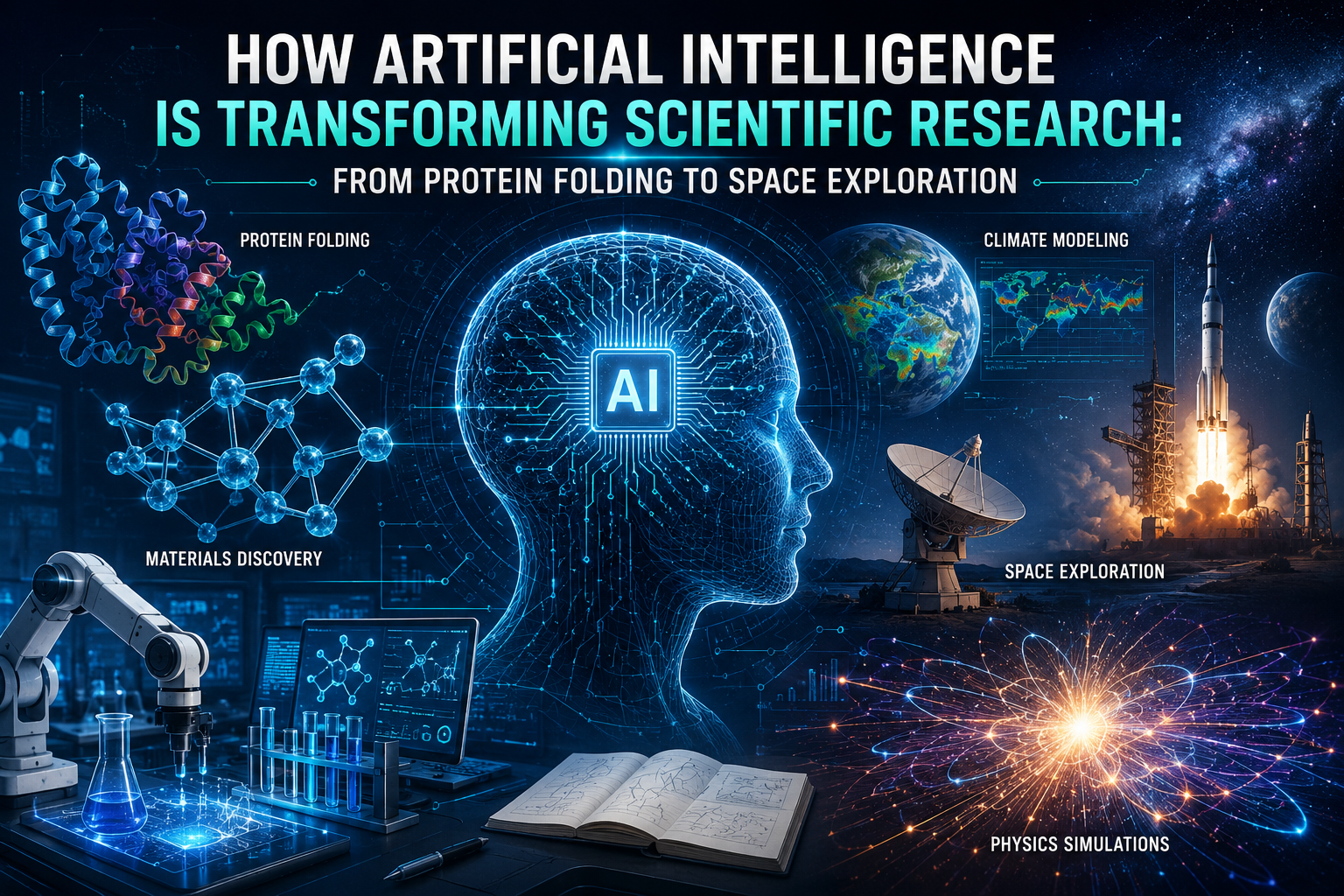
This achievement marked more than a milestone in artificial intelligence. How AI is transforming scientific research It demonstrated a broader shift in how scientific research is conducted. AI is no longer limited to automating routine tasks or analysing large datasets. It has become a powerful partner in scientific discovery, helping researchers generate hypotheses, identify hidden patterns, design experiments, and solve problems that once required enormous computational resources or decades of human effort.
Across laboratories worldwide, AI is transforming nearly every scientific discipline. Chemists use it to discover new materials. Climate scientists improve weather forecasts with machine learning. Astronomers analyze massive volumes of telescope data to identify distant galaxies and exoplanets. Physicists accelerate complex simulations that previously required supercomputers running for weeks. Engineers optimize energy systems, while medical researchers develop new drugs at unprecedented speeds.
What makes this transformation remarkable is not simply the increase in computing power. Modern AI systems excel at recognizing complex relationships within enormous datasets. They can identify subtle patterns that humans may overlook, helping scientists make faster, more informed decisions while reducing the cost and time required for research.
However, AI is not a magic solution. Scientific discovery still depends on rigorous experimentation, peer review, domain expertise, and careful interpretation. AI-generated predictions must be validated in laboratories and through real-world testing. Understanding both the strengths and limitations of AI is essential for responsible scientific progress.
This article explores how artificial intelligence is reshaping modern science across multiple disciplines. We will examine real-world applications, measurable impacts, current limitations, emerging opportunities, and the skills needed to participate in this rapidly evolving field.
Contents
Why Scientific Research Needed AI
Scientific research has always relied on three fundamental resources:
- Data
- Time
- Human expertise
During the last two decades, scientific instruments have begun generating data at extraordinary rates. Modern DNA sequencing machines, satellites, particle accelerators, and telescopes produce petabytes of information annually.
For example:
| Field | Typical Data Generated |
|---|---|
| Genomics | Millions of DNA sequences |
| Astronomy | Petabytes of telescope images |
| Climate Science | Continuous global satellite observations |
| Particle Physics | Billions of particle collision events |
| Materials Science | Millions of possible molecular structures |
Traditional statistical methods and manual analysis struggle to keep pace with this data explosion.
Artificial intelligence addresses this challenge by identifying meaningful patterns, prioritizing promising candidates, and reducing computational workloads.
Think of AI as an intelligent research assistant. Instead of replacing scientists, it helps them focus on the most promising experiments.
AI in Materials Discovery
What Is Materials Discovery?
Every modern technology depends on advanced materials.
Smartphones require specialized semiconductors.
Electric vehicles need efficient batteries.
Aircraft depend on lightweight alloys.
Solar panels require materials that efficiently convert sunlight into electricity.
Finding better materials has always been a slow and expensive scientific process.
Researchers traditionally:
- Design a material.
- Manufacture it.
- Test its properties.
- Analyze results.
- Repeat thousands of times.
This cycle often takes years.
The Traditional Challenge
Imagine searching for a single grain of sand on an entire beach.
That is similar to discovering useful materials.
Scientists estimate that billions of possible material combinations exist.
Only a tiny fraction has ever been experimentally tested.
Traditional experimentation requires:
- expensive laboratory equipment
- specialized researchers
- repeated testing
- extensive computational simulations
Even with modern computers, exploring every possible combination is impossible.
How AI Changes the Process
Machine learning models learn relationships between a material’s atomic structure and its physical properties.
Instead of testing millions of possibilities experimentally, AI predicts which candidates are most likely to succeed.
Researchers then test only the most promising materials.
This dramatically reduces:
- research time
- experimental cost
- computational requirements
AI-Assisted Materials Discovery Workflow
| Traditional Workflow | AI-Assisted Workflow |
|---|---|
| Random experimentation | Intelligent prediction |
| Thousands of experiments | Hundreds of experiments |
| Years of development | Months in many cases |
| High cost | Lower research cost |
| Manual optimization | Automated optimization |
Real-World Example: Better Batteries
Electric vehicles require batteries with:
- higher energy density
- faster charging
- improved safety
- longer lifespan
Researchers use AI to search through millions of chemical combinations for new battery materials.
Organizations including Microsoft and Pacific Northwest National Laboratory have demonstrated AI-assisted methods that significantly reduce the search space for potential battery materials, allowing researchers to identify promising candidates much faster than conventional screening alone.
Sustainable Materials
Climate change has increased demand for environmentally friendly materials.
AI helps identify:
- recyclable plastics
- biodegradable polymers
- carbon-capturing materials
- efficient catalysts
- greener cement formulations
Rather than testing every chemical combination experimentally, AI predicts which molecular structures are most likely to exhibit desired properties.
Semiconductor Innovation
Modern computer chips depend on advanced semiconductor materials.
AI assists researchers by:
- predicting electrical conductivity
- identifying heat-resistant compounds
- optimizing manufacturing processes
- discovering materials for next-generation computing
These advances are particularly important as traditional semiconductor scaling becomes more challenging.
Aerospace Materials
Aircraft and spacecraft require materials that are:
- extremely strong
- lightweight
- heat resistant
- corrosion resistant
AI helps engineers optimize alloys for these demanding environments, reducing the number of costly physical prototypes.
Organizations in aerospace increasingly combine AI with digital simulations to accelerate materials engineering.
Benefits of AI in Materials Discovery
✔ Faster discovery cycles
✔ Lower research costs
✔ Reduced laboratory waste
✔ Better renewable energy technologies
✔ Improved batteries
✔ More efficient electronics
✔ Sustainable manufacturing
Current Limitations
Despite impressive progress, AI cannot independently invent new materials.
Challenges include:
- Limited high-quality training data
- Experimental validation remains essential
- Models may not generalize to entirely new chemical systems
- Predictions can be difficult to interpret
AI suggests possibilities. Scientists determine whether they work in reality.
Summary : AI in Materials Discovery
What AI Does Well
- Screens millions of candidates quickly
- Predicts material properties
- Reduces experimentation time
- Optimizes manufacturing
What Still Requires Humans
- Laboratory synthesis
- Experimental validation
- Safety testing
- Commercial scaling
AI in Protein Design
Understanding Proteins
Proteins are often described as the building blocks and molecular machines of life. They perform a vast range of essential functions, including transporting oxygen, fighting infections, repairing tissues, catalyzing chemical reactions, and regulating cellular processes.
A protein begins as a linear chain of amino acids, but its biological function depends on how that chain folds into a complex three-dimensional structure. Predicting this structure from the amino acid sequence alone has been one of biology’s greatest challenges because there are an astronomical number of possible folding arrangements.
For decades, researchers relied on experimental techniques such as X-ray crystallography, nuclear magnetic resonance (NMR) spectroscopy, and cryo-electron microscopy to determine protein structures. While these methods are highly accurate, they can be time-consuming, expensive, and not always successful for every protein.
This bottleneck slowed progress in many areas of medicine and biotechnology.
How AI Changed Protein Structure Prediction
The introduction of AlphaFold2 by DeepMind and subsequent advances from groups such as Institute for Protein Design transformed the field. By training on decades of experimentally determined protein structures, AI systems learned to predict how proteins fold with remarkable accuracy for many proteins.
Researchers who once waited months or years for structural information can now obtain high-quality predictions in hours or days, allowing them to focus laboratory efforts on validation and application rather than initial structure determination.
The impact extends across multiple domains:
- Drug discovery: Identifying binding sites for new medicines.
- Vaccine development: Understanding viral proteins to design more effective vaccines.
- Rare disease research: Studying proteins linked to genetic disorders.
- Agriculture: Engineering proteins that improve crop resilience.
- Industrial biotechnology: Designing enzymes for cleaner manufacturing processes.
Case Example: Enzyme Engineering
Industries increasingly use enzymes to replace energy-intensive chemical processes. AI helps scientists design enzymes that work under specific temperatures, pH levels, or industrial conditions, reducing waste and improving efficiency.
Benefits
- Faster biological research
- Lower costs for structural biology
- Improved drug target identification
- Acceleration of synthetic biology
- Greater access to structural data for researchers worldwide
Limitations
AI-predicted structures are powerful starting points, not final proof. Scientists must still confirm predictions experimentally, particularly for proteins that change shape, interact with other molecules, or exist in complex cellular environments. Designing entirely new proteins with desired functions also remains an active area of research with significant scientific challenges.
Summary : AI in Protein Design
AI Accelerates
- Protein structure prediction
- Drug target discovery
- Enzyme design
- Biological hypothesis generation
Human Expertise Remains Essential For
- Experimental validation
- Clinical testing
- Understanding biological mechanisms
- Translating discoveries into safe therapies
To Read part 2 Click here